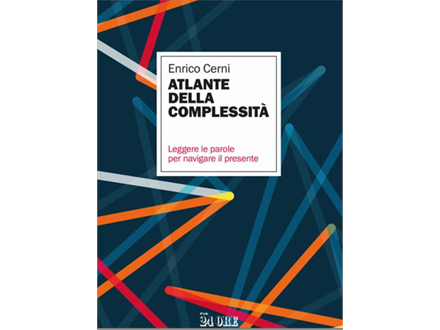


I discovered Enrico Cerni through his publication “Dante per manager,” in which the author, with insight and originality, guides readers on a journey of “management” through the Divine Comedy and its characters, where the final goal remains Paradise, the kingdom of corporate virtues, in which the blessed serve as role models for behavior, both medieval and contemporary.
Reading Enrico's texts is like unwrapping a gift he offers to readers, showcasing his vast linguistic and substantive expertise along with the ability to make complex concepts accessible, fostering profound and stimulating reflection that is never banal.
I couldn’t miss his latest publication, the “Atlante della complessita''”!
In my reading journey of Enrico’s latest work, I found new insights and a method I wish to share not only for their beauty and usefulness but also for how they resonate with my approach to life and my work as a coach. It's impossible to mention them all in a blog post! So, I’ve selected a few.
The book shows us how complexity can be inhabited, not dominated.
I often invite my Coachees to “stay within” the flow, allowing thoughts and emotions to emerge naturally, without immediately pigeonholing them (as our sequential thinking tends to do!), without fear of losing ourselves, trusting the process that will unveil each time anew and uniquely. Similarly, Cerni encourages readers to have references while also being ready to go beyond them: “methodos is the path to take to reach a certain place… it signifies research, investigation… anyone who wants to search must have a way and go beyond it… method is not a rigid scheme; it is not a standard.”
Amid all this positivity, the only aspect where I feel I must challenge the author of the “Atlas of Complexity” is the proposal of a list of interwoven routes at the end of each chapter. While I intuitively appreciate the suggestion, I wonder: why indicate these intertwining paths when the beauty of discovery and its journeys are exquisitely individual? Each reader has their unique journey, and the potential for interconnections and perspectives is infinite.
In conclusion, Cerni tackles complex themes, unraveling them with love, competence, professionalism, and a poetic lightness that makes reading (or rather, navigating!) not only informative but also particularly enjoyable. A navigation that, if internalized, expresses its transformative potential: the journey through complexity becomes an inner journey within the first complex system we inhabit: ourselves.
In a VUCA (Volatile, Uncertain, Complex, and Ambiguous) world, the ability to navigate complexity is a fundamental skill we can all cultivate. To inhabit complexity means embracing uncertainty and acknowledging that there is not a single truth but a multitude of perspectives that render our shared journey surprising and rich in meaning.
Happy reading!
 ABOUT ME
MY PUBLICATIONS
COLLABORATIONS
BLOG
MODEL FOR INDIVIDUALS
MODEL FOR BUSINESSES
FOR WHOM: Individuals
FOR WHOM: Businesses
Solutions
BEST SELLERS: INDIVIDUALS
BEST SELLERS: BUSINESSES
ENDORSMENTS
CONTACT ME
ABOUT ME
MY PUBLICATIONS
COLLABORATIONS
BLOG
MODEL FOR INDIVIDUALS
MODEL FOR BUSINESSES
FOR WHOM: Individuals
FOR WHOM: Businesses
Solutions
BEST SELLERS: INDIVIDUALS
BEST SELLERS: BUSINESSES
ENDORSMENTS
CONTACT ME